Corporate Tax in UAE – Ultimate 2026 Guide by QRS Audit
The United Arab Emirates (UAE) continues to be one of the world’s most dynamic business hubs, attracting entrepreneurs, investors, and global corporations. Over the past decade, the UAE has steadily strengthened its regulatory framework, ensuring a transparent, stable, and globally-aligned business environment. For companies operating here, understanding the evolving corporate obligations is essential to thrive and avoid regulatory pitfalls.
At QRS Audit, we advise businesses across sectors, from small startups to multinational corporations. This guide explores key aspects of corporate compliance in the UAE as of 2026, providing practical insights to help businesses navigate requirements efficiently.
1. Understanding the UAE’s Business Environment
The UAE’s economic landscape is highly diverse. Beyond its traditional oil and gas industries, the country has rapidly expanded into finance, logistics, tourism, technology, and renewable energy. This diversification has prompted regulators to implement structured compliance frameworks that enhance business credibility and align local practices with international standards.
Compliance in this context isn’t just about legal adherence—it’s about operational excellence. Companies that implement structured reporting, recordkeeping, and internal controls strengthen their credibility with investors, partners, and regulators alike.
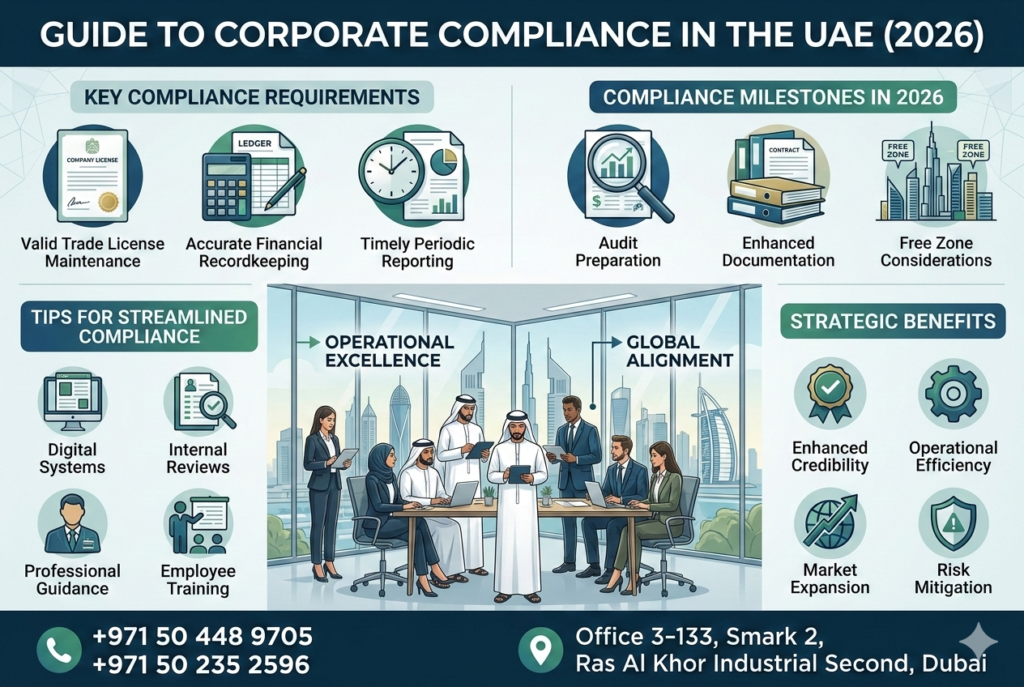
2. Key Compliance Requirements for UAE Businesses
Businesses in the UAE, whether in free zones or on the mainland, must adhere to a set of corporate requirements. While specifics can vary by business type, there are several core areas that every company should address.
1 Company Registration and Licensing
All businesses must maintain a valid trade license, issued by the relevant authority based on the nature of their activities. Free zones like DMCC, JAFZA, and DIFC provide specialized licensing structures, but even free zone companies must comply with federal corporate frameworks for regulatory reporting.
Accurate registration ensures smooth interactions with banks, government entities, and clients. Any lapse in licensing can result in penalties or operational restrictions.
2 Financial Recordkeeping
Maintaining organized, up-to-date financial records is fundamental. Companies should track all income, expenses, contracts, and transactions, ensuring documentation is clear and verifiable. Audited statements are increasingly recommended for businesses above certain thresholds to demonstrate transparency and accuracy in financial reporting.
Even small businesses benefit from consistent recordkeeping, as it helps in budgeting, decision-making, and identifying growth opportunities.
3 Periodic Reporting
The UAE emphasizes timely and accurate reporting. Companies are required to submit periodic statements and disclosures, ensuring regulators have access to up-to-date information about business operations. Meeting deadlines is crucial; late submissions may attract fines or additional scrutiny.
At QRS Audit, we encourage clients to integrate compliance calendars into their business operations to avoid last-minute stress and errors.
3. Compliance Milestones in 2026
As the UAE’s business landscape evolves, certain milestones have emerged as critical for companies to maintain compliance:
1 Audit Preparation
Audits are no longer optional for many companies. Firms with higher revenues or complex structures are expected to maintain audited accounts. Audits help verify that companies’ financial practices meet regulatory expectations and provide confidence to stakeholders.
2 Enhanced Documentation
Businesses are required to maintain comprehensive supporting documentation for all transactions, agreements, and financial activities. This includes contracts, invoices, bank statements, and internal reports. Proper documentation not only ensures compliance but also facilitates strategic business decisions.
3 Free Zone Considerations
While free zones offer incentives and benefits, companies must satisfy specific operational and substance requirements to maintain compliance. This includes demonstrating actual economic activity, proper staffing, and adherence to reporting standards.
4. Common Misconceptions
Even seasoned business owners in the UAE sometimes misunderstand regulatory requirements. Common misconceptions include:
“Free zone companies are fully exempt from obligations.”
While free zones provide certain benefits, companies must still comply with federal regulations and reporting requirements.“Only large companies need compliance measures.”
Small and medium enterprises are equally responsible for maintaining proper records, submitting reports, and adhering to licensing requirements.“Records are only necessary for inspections.”
Regular recordkeeping supports operational clarity, internal audits, and strategic planning, not just compliance checks.
5. Tips for Streamlined Compliance
Practical steps can help companies stay ahead of obligations and reduce the administrative burden:
1 Digital Recordkeeping
Adopt cloud-based or digital accounting systems to organize financial and operational data. This simplifies reporting, reduces human errors, and ensures records are easily accessible for internal review or audits.
2 Regular Internal Reviews
Conduct quarterly internal checks to ensure that financial statements, agreements, and reports are accurate. Identifying discrepancies early prevents costly corrections later.
3 Professional Guidance
Engaging experts such as QRS Audit can provide businesses with guidance on structuring operations, maintaining records, and ensuring compliance. Professional oversight often identifies gaps that might be overlooked internally.
4 Employee Training
Staff involved in financial reporting, administration, or corporate governance should receive regular training on UAE regulations and internal policies. Awareness reduces errors and strengthens corporate discipline.
6. Strategic Benefits of Compliance
Beyond avoiding penalties, compliance offers tangible benefits for businesses:
Enhanced Credibility – Investors and partners gain confidence in businesses that follow structured governance and reporting practices.
Operational Efficiency – Organized systems streamline operations, reduce duplication, and improve decision-making.
Market Expansion – Businesses with strong compliance frameworks can more easily access international markets and partnerships.
Risk Mitigation – Proactive adherence reduces exposure to fines, disputes, or reputational damage.
Compliance, therefore, is not just a regulatory requirement; it’s a strategic advantage for growth and sustainability.
7. Preparing for the Future
As 2026 progresses, UAE businesses must anticipate further regulatory enhancements. Areas to monitor include:
Updates to reporting frameworks for free zone entities.
Integration of technology solutions for compliance and reporting.
Increased emphasis on corporate governance, transparency, and accountability.
Companies that invest in structured compliance, auditing systems, and professional guidance are better positioned to adapt to future regulatory shifts.
Conclusion
Operating in the UAE’s dynamic business environment requires a proactive approach to compliance. By understanding the regulatory landscape, maintaining accurate records, and seeking professional guidance, businesses can navigate 2026 successfully.
At QRS Audit, we specialize in helping businesses of all sizes implement effective compliance strategies, streamline operations, and strengthen corporate governance. Proper preparation today not only ensures smooth operations but also sets the stage for sustainable growth and long-term success in the U
FAQ
How much corporate tax is in the UAE?
The UAE corporate tax rate is 9% on taxable income exceeding AED 375,000. Businesses with taxable income below this threshold pay 0%. Certain sectors, like oil and gas or branches of foreign banks, may have different rates
Who must pay the UAE corporate tax?
All UAE-based businesses and foreign entities generating income in the UAE are subject to corporate tax, except for businesses operating in free zones that meet specific regulatory conditions.
What is qualifying income in UAE corporate tax?
Qualifying income generally includes all profits from business activities conducted in the UAE. This covers revenue from sales, services, investments, and other commercial activities, minus allowable expenses and deductions.
What is an example of a corporate tax in UAE?
A company earning AED 500,000 in taxable profits would calculate:
Taxable income above threshold = 500,000 – 375,000 = 125,000
Corporate tax = 9% of 125,000 = AED 11,250
How to reduce corporate tax in UAE?
Strategies include:
Utilizing allowable deductions (operating expenses, depreciation).
Structuring business through approved free zone entities.
Engaging in tax planning services from experts like QRS Audit.
What is the difference between VAT and corporate tax in the UAE?
VAT (Value Added Tax) is a consumption tax (currently 5%) on goods and services.
Corporate tax is a tax on profits earned by businesses.
How is corporation tax calculated?
Determine total taxable income.
Subtract allowable deductions.
Apply the 9% rate on income above AED 375,000.
Account for any exemptions or special treatments.
What's the difference between corporate tax and income tax?
Corporate tax: levied on company profits.
Income tax: levied on individual salaries, wages, or personal income. The UAE currently has no personal income tax